Tatlin’s Whisper #6
Audio Guide




Broadway between 46th & 47th Sts
New York, NY

Start:
May 1, 2026
End:
May 1, 2026

12–1pm

View Public Programming

Broadway between 46th & 47th Sts
New York, NY
Start:
May 1, 2026
End:
May 1, 2026
12–1pm
View Public Programming
In a performance at the 2009 Havana Biennial, Tania Bruguera presented Tatlin’s Whisper #6 as a temporary platform for the free speech normally denied in Cuba. Audience members were invited to step forward and speak uncensored for one minute, before being escorted away. The work has become one of the defining performances of the 21st century—an enduring meditation on free expression, civic participation, and the fragile conditions under which speech becomes possible.
In 2015, a version of the performance was staged in Times Square in partnership with Creative Time, four months after the artist was arrested for attempting to enact the performance in Havana’s Plaza de la Revolution in December 2014. Now in 2026, at a moment of renewed urgency around democracy, dissent, and the rights of assembly and expression, the work returns to Times Square in partnership with Fall of Freedom.
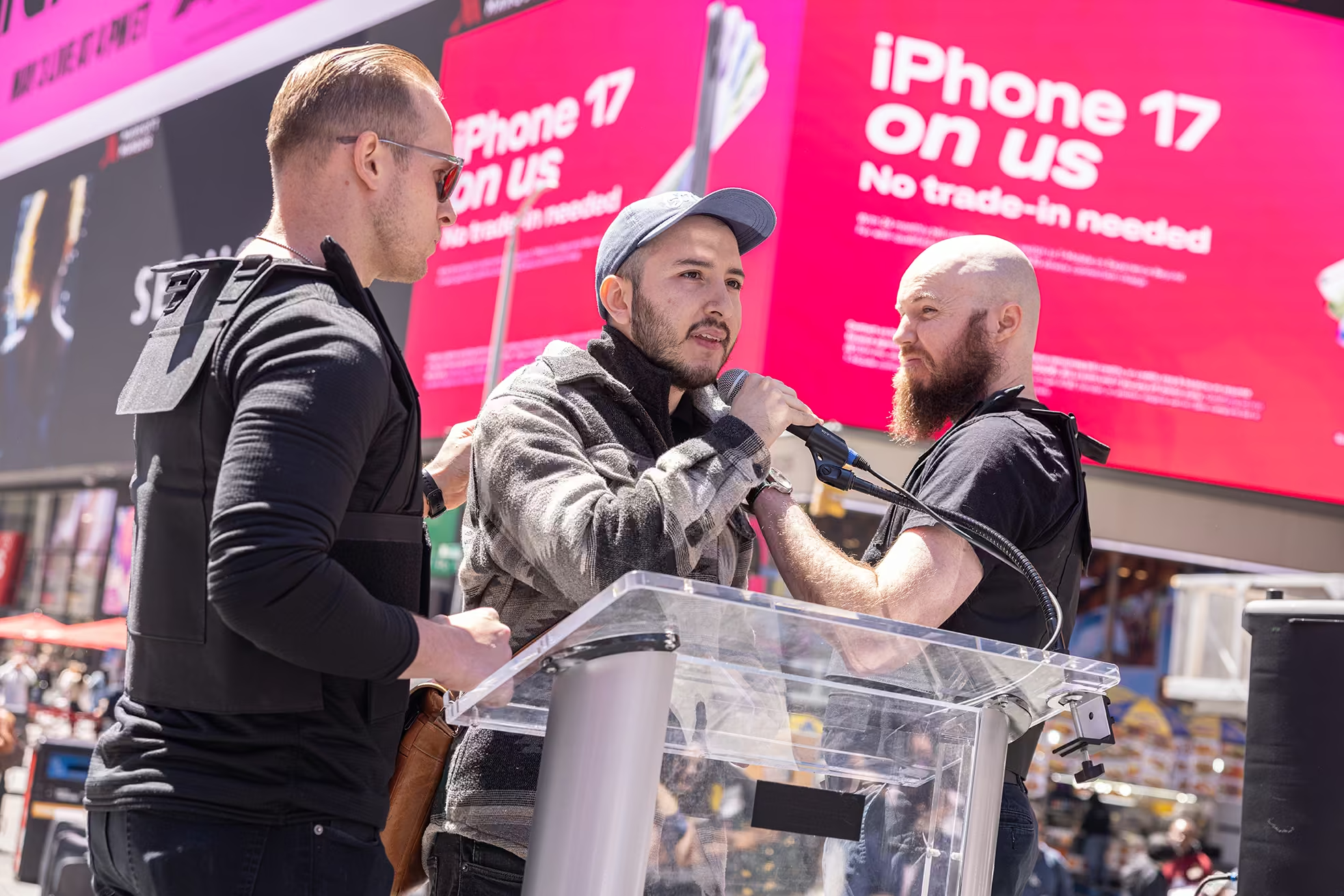
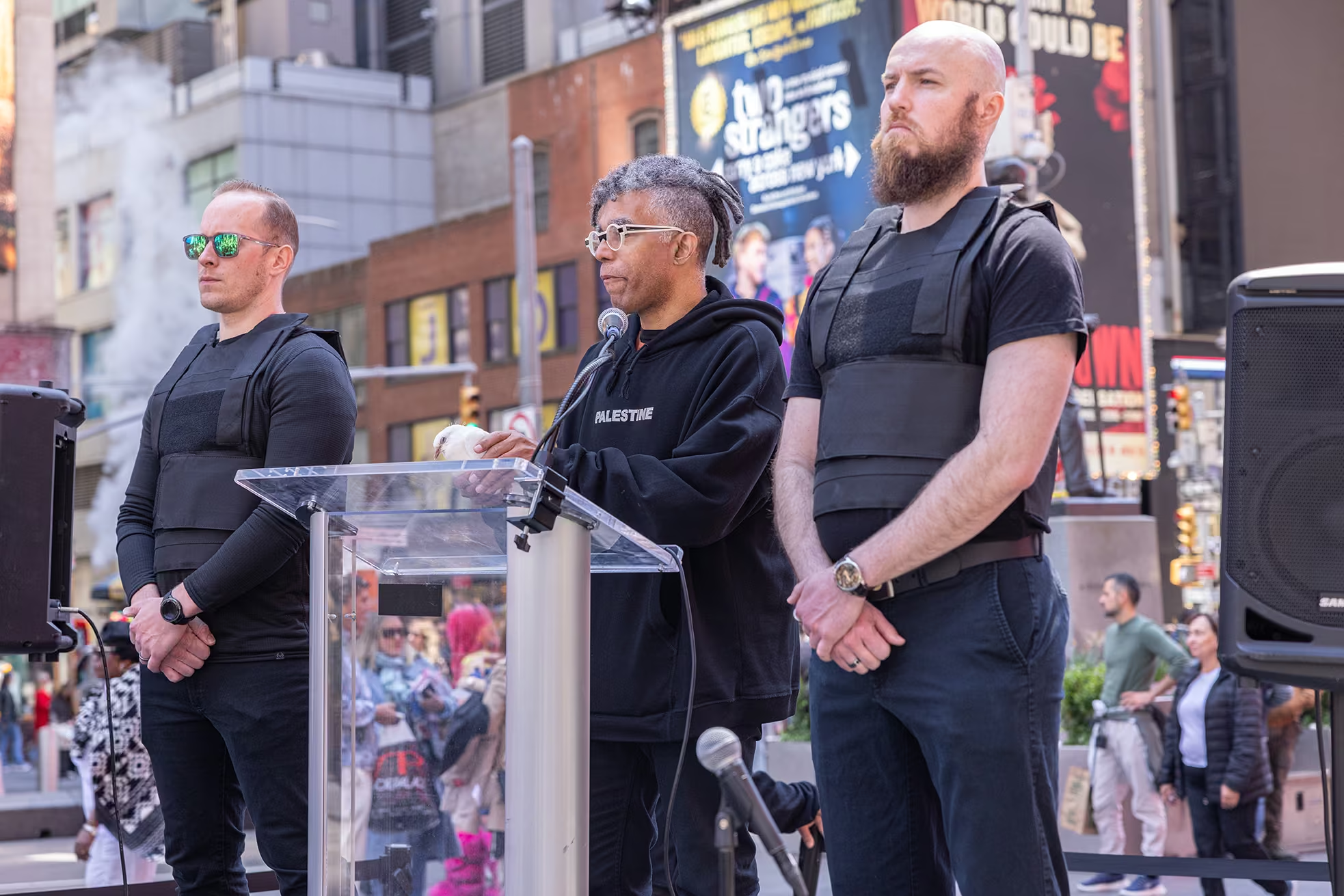
The performance is conceived around a simple setup: a microphone, a raised platform, and an open invitation to the public to step forward, one by one, to speak before the audience and passersby. White doves will be briefly placed on the speakers’ shoulders. Each participant’s contribution will be constrained by time, underscoring how liberty is so often granted conditionally, temporarily, or at risk.
Tatlin’s Whisper #6 identifies a common thread across autocratic and dictatorial regimes: the systematic suppression of free speech, often legitimized through states of exception, competing political imperatives, or the insistence that dissent be suspended in the name of “broader achievements.” This dynamic normalizes the premise that silence is a necessary condition for stability, progress, or the collective good, effectively enforcing a form of civic coercion.
“Freedom of expression is taken each time silence feels safer than speech, each time convenience outweighs conviction, each time we mistake the absence of punishment for the presence of freedom.” — Tania Bruguera
In a performance at the 2009 Havana Biennial, Tania Bruguera presented Tatlin’s Whisper #6 as a temporary platform for the free speech normally denied in Cuba. Audience members were invited to step forward and speak uncensored for one minute, before being escorted away. The work has become one of the defining performances of the 21st century—an enduring meditation on free expression, civic participation, and the fragile conditions under which speech becomes possible.
In 2015, a version of the performance was staged in Times Square in partnership with Creative Time, four months after the artist was arrested for attempting to enact the performance in Havana’s Plaza de la Revolution in December 2014. Now in 2026, at a moment of renewed urgency around democracy, dissent, and the rights of assembly and expression, the work returns to Times Square in partnership with Fall of Freedom.
The performance is conceived around a simple setup: a microphone, a raised platform, and an open invitation to the public to step forward, one by one, to speak before the audience and passersby. White doves will be briefly placed on the speakers’ shoulders. Each participant’s contribution will be constrained by time, underscoring how liberty is so often granted conditionally, temporarily, or at risk.
Tatlin’s Whisper #6 identifies a common thread across autocratic and dictatorial regimes: the systematic suppression of free speech, often legitimized through states of exception, competing political imperatives, or the insistence that dissent be suspended in the name of “broader achievements.” This dynamic normalizes the premise that silence is a necessary condition for stability, progress, or the collective good, effectively enforcing a form of civic coercion.
“Freedom of expression is taken each time silence feels safer than speech, each time convenience outweighs conviction, each time we mistake the absence of punishment for the presence of freedom.” — Tania Bruguera
Fall of Freedom is an urgent call to the arts community to unite in defiance of authoritarian forces sweeping the nation. Beginning May 1, 2026, galleries, museums, libraries, comedy clubs, theaters, and concert halls across the country will host exhibitions, performances, and public events that channel the urgency of this moment. Fall of Freedom is an open invitation to artists, creators, and communities to take part—and to celebrate the experiences, cultures, and identities that shape the fabric of our nation.

Tatlin’s Whisper #6 is presented by Times Square Arts, in partnership with Fall of Freedom.
Support for Tatlin’s Whisper #6 is provided in part by the New York State Council on the Arts with the support of the Office of the Governor and the New York State Legislature, and public funds from the New York City Department of Cultural Affairs in partnership with the City Council.
Tatlin's Whisper #6 (Havana Version) is on loan from the Solomon R. Guggenheim Museum, New York.



Broadway between 46th & 47th Sts
New York, NY

12–1pm
Tania Bruguera, "Tatlin's Whisper #6 (Havana Version)," 2009. Solomon R. Guggenheim Museum, New York, Guggenheim UBS MAP Purchase Fund, 2014.


Tania Bruguera (b. 1968) is a Cuban artist and activist whose work centers on installation and performance. She lives in Cambridge, where she serves as head of media and performance at Harvard University. Bruguera has participated in major international exhibitions, including Documenta 11 and Documenta 15, as well as the Venice Biennale (2001, 2005, 2009, 2015). Her work is held in the permanent collections of institutions such as Museum of Modern Art, Tate Modern, and Bronx Museum of the Arts.
Bruguera’s practice interrogates structures of power and control, often re-presenting conditions shaped by autocratic and dictatorial regimes. As a result of her artistic actions and civic engagement, she has been repeatedly detained by Cuban authorities.
Learn More About
Tania Bruguera

Tania Bruguera (b. 1968) is a Cuban artist and activist whose work centers on installation and performance. She lives in Cambridge, where she serves as head of media and performance at Harvard University. Bruguera has participated in major international exhibitions, including Documenta 11 and Documenta 15, as well as the Venice Biennale (2001, 2005, 2009, 2015). Her work is held in the permanent collections of institutions such as Museum of Modern Art, Tate Modern, and Bronx Museum of the Arts.
Bruguera’s practice interrogates structures of power and control, often re-presenting conditions shaped by autocratic and dictatorial regimes. As a result of her artistic actions and civic engagement, she has been repeatedly detained by Cuban authorities.
Learn More About
Tania Bruguera
Tania Bruguera (b. 1968) is a Cuban artist and activist whose work centers on installation and performance. She lives in Cambridge, where she serves as head of media and performance at Harvard University. Bruguera has participated in major international exhibitions, including Documenta 11 and Documenta 15, as well as the Venice Biennale (2001, 2005, 2009, 2015). Her work is held in the permanent collections of institutions such as Museum of Modern Art, Tate Modern, and Bronx Museum of the Arts.
Bruguera’s practice interrogates structures of power and control, often re-presenting conditions shaped by autocratic and dictatorial regimes. As a result of her artistic actions and civic engagement, she has been repeatedly detained by Cuban authorities.
Learn More About
Tania Bruguera